


 Home
HomeFlexible LED Backlight Sheets: A Complete Guide for Stone, Signage and Display Lighting
 Aug 17,2026

 SYP
SYP
Choosing between 12V and 24V LED strip lights may seem like a minor technical decision, but voltage affects almost every part of a cabinet lighting system. It influences run length, wiring, voltage drop, driver selection, installation efficiency and the consistency of the finished light.
For a small display cabinet, either voltage may work well. For a custom kitchen, walk-in closet, retail display or multi-cabinet installation, selecting the right voltage at the design stage can prevent dim sections, oversized wiring and unnecessary installation work.
This guide compares 12V and 24V LED strips and explains how cabinet makers, contractors, designers and lighting specifiers can choose the right system for each project.
What Is the Difference Between 12V and 24V LED Strip Lights?
Both products are low-voltage LED lighting systems. A 12V strip must be connected to a compatible 12V DC power supply, while a 24V strip requires a 24V DC power supply. The strip, driver, dimmer, controller and other components must all be electrically compatible.
The most important practical difference is current. For the same wattage, a 24V system draws approximately half the current of a 12V system.
Electrical current = Power ÷ Voltage
For example, a 96-watt lighting load draws approximately:
- 8 amps at 12V
- 4 amps at 24V
Lower current can reduce voltage drop and make longer cable runs easier to manage. This is one of the main reasons 24V LED lighting is frequently specified for professional cabinetry and architectural millwork.
12V vs 24V LED Strip Lights: Quick Comparison
| Feature | 12V LED Strip | 24V LED Strip |
|---|---|---|
| Typical application | Small cabinets and short lighting sections | Kitchens, closets, retail displays and longer installations |
| Current at equal wattage | Higher | Approximately half that of 12V |
| Voltage drop | More noticeable over long runs | Easier to control over longer runs |
| Wiring requirements | May require heavier wire at higher loads | Lower current can simplify power distribution |
| Cutting flexibility | May offer shorter cutting intervals, depending on the strip | Cutting intervals may be longer, depending on the strip |
| Large project suitability | Best for localized lighting | Usually better for multi-cabinet systems |
Note: Exact maximum run lengths, cut points and wattage depend on the individual LED strip. Always check the product specification sheet before finalizing a design.
Why Voltage Drop Matters in Cabinet Lighting
Voltage drop is the gradual reduction in voltage as electricity travels through a wire or LED strip. When the drop becomes significant, the LEDs near the end of the run may appear dimmer than those near the power source. Color temperature can also look less consistent across the installation.
Voltage drop is affected by several factors:
- Total LED strip length
- Wattage per foot or meter
- Wire length and wire gauge
- Number and quality of connectors
- Location of the power supply
- Whether power is supplied from one end, both ends or multiple points
Because a 24V system carries less current for the same power, it generally performs better over longer distances. This can produce more consistent brightness across long shelves, wardrobe sections and continuous under-cabinet installations.
When Should You Choose 12V LED Cabinet Lighting?
A 12V system remains a practical choice for smaller, self-contained lighting applications. It can be especially useful when an existing project already has a compatible 12V power supply or control system.
Consider 12V LED lighting when:
- The illuminated section is short.
- Each cabinet has an independent power feed.
- The project uses existing 12V components.
- Short cutting increments are required and supported by the selected strip.
- The total lighting load is relatively low.
- A 12V puck light or specialty fixture is part of the design.
Typical applications include a single display cabinet, a small vanity, a short drawer light or a compact shelving unit.
A well-designed 12V system can deliver excellent results. Problems usually arise when a short-run system is extended beyond its intended electrical limits without additional power feeds.
When Is 24V LED Cabinet Lighting the Better Choice?
For professional cabinet lighting, 24V is often the more scalable option. Lower current makes it easier to distribute power across multiple cabinets while maintaining consistent output.
Consider 24V LED lighting for:
- Long kitchen cabinet runs
- Walk-in closets and wardrobe systems
- Continuous shelf lighting
- Retail display fixtures
- Showcases and museum-style cabinets
- Commercial millwork
- Projects with centralized power supplies
- High-output linear lighting systems
Many professional cabinet and wardrobe lighting solutions use 24V architecture because it supports longer runs and efficient low-voltage distribution. It is particularly useful when several lighting zones must operate from one properly sized driver.
Does 24V Produce Brighter Light Than 12V?
Not automatically. Voltage alone does not determine brightness.
Brightness depends on the LED package, diode density, wattage, optical design, diffuser and operating current. A high-quality 12V strip can be brighter than a low-output 24V strip. The correct comparison should be based on measurable specifications such as:
- Lumens per foot or meter
- Watts per foot or meter
- LED density
- Color Rendering Index (CRI)
- Color temperature (CCT)
- Beam angle and diffuser transmission
The main advantage of 24V is not inherently greater brightness. It is the ability to maintain more consistent electrical performance across longer runs.
How to Choose the Right LED Strip for Cabinets
1. Determine the Lighting Purpose
Start by deciding whether the light will be used for task lighting, accent lighting or product display.
- Task lighting: Requires sufficient, evenly distributed output for countertops and work surfaces.
- Accent lighting: Uses lower or dimmable output to add depth and atmosphere.
- Display lighting: Requires controlled glare and accurate color rendering.
- Closet lighting: Benefits from sensors, high CRI and concealed linear profiles.
2. Calculate the Total Wattage
Multiply the strip wattage per foot or meter by the total installed length.
Total lighting wattage = Strip wattage per unit length × Total length
If a strip consumes 4 watts per foot and the project requires 20 feet, the connected lighting load is 80 watts. The power supply should be selected according to the manufacturer's loading guidelines, with appropriate capacity for reliable operation.
3. Select the Correct Driver
A constant-voltage LED strip requires a compatible constant-voltage driver. Never connect a 12V strip to a 24V driver, as the excessive voltage can damage the LEDs. A 24V strip connected to a 12V driver may fail to illuminate correctly.
When dimming is required, confirm that the driver, controller and dimming method are compatible. Depending on the project, options may include low-voltage PWM control, 0-10V control, phase-cut dimming or wireless control.
Explore compatible LED drivers and controls before completing the wiring design.
4. Check CRI and Color Temperature
For cabinetry and display lighting, light quality is just as important as brightness. A high CRI helps wood finishes, clothing, food, stone and merchandise appear more natural.
Common color-temperature choices include:
- 2700K: Warm and decorative; well suited to traditional interiors.
- 3000K: Warm white for residential kitchens, closets and hospitality spaces.
- 4000K: Neutral white for task lighting and contemporary commercial interiors.
- 5000K and above: Cooler appearance for selected retail or utility applications.
For a cohesive result, coordinate the cabinet lighting color temperature with the room's ceiling fixtures, decorative lighting and surrounding materials.
5. Decide Between SMD and COB LED Strips
Traditional SMD strips place individual LED packages at regular intervals. If diode spacing is visible through the diffuser, the installation may show bright dots or hot spots.
COB technology uses a high density of light-emitting chips to create a more continuous line of light. This makes COB LED strips especially useful in shallow aluminum profiles, reflective cabinets, glass shelves and premium display applications where a smooth, dot-free appearance is important.
6. Choose the Right Aluminum Profile
An aluminum profile protects the strip, supports heat management and gives the installation a clean architectural finish. Available configurations may include:
- Surface-mounted profiles
- Recessed or flush-mounted profiles
- Corner and angled profiles
- Suspended linear profiles
- Solder-free cabinet lighting profiles
The profile should fit both the LED strip width and the cabinet construction detail. The diffuser depth and LED density should also be considered together to avoid visible spotting.
Professional Wiring Tips for 12V and 24V Systems
A professional result depends on more than choosing the correct voltage. Use these planning practices to improve reliability and serviceability:
- Wire long cabinet sections in parallel. Avoid connecting multiple long strips end to end when this exceeds the strip's rated run length.
- Keep drivers accessible. Do not permanently bury a power supply behind finished cabinetry or drywall.
- Use the correct wire gauge. Longer distances and higher currents may require larger conductors.
- Reduce unnecessary cable length. Position drivers and distribution points strategically.
- Test before final installation. Operate the complete system before installing diffusers or closing cabinet panels.
- Label lighting zones. This simplifies commissioning, maintenance and future replacement.
- Check polarity. Constant-voltage DC LED systems require correct positive and negative connections.
Electrical connections and mains-voltage work should follow applicable local codes and be completed by a qualified professional when required.
Which Voltage Is Best for Cabinet Makers and Contractors?
For a single short cabinet, 12V can be simple and effective. For larger kitchens, custom closets, retail millwork and multi-zone installations, 24V is generally easier to scale and manage.
The decision can be summarized as follows:
- Choose 12V for compact, low-load and independently powered applications.
- Choose 24V for longer runs, centralized drivers and professional multi-cabinet systems.
Voltage should never be selected in isolation. The best system combines the correct strip, driver, wire, profile, diffuser, sensor and control method.
Frequently Asked Questions
Can I connect a 12V LED strip to a 24V power supply?
No. A 24V power supply can overdrive and permanently damage a 12V LED strip. Always match the strip voltage to the output voltage of the power supply.
Can 12V and 24V LED lights be used in the same project?
Yes, but they must use separate compatible power supplies or properly engineered voltage conversion. Combining both voltages generally adds complexity, so a single system voltage is preferable when possible.
Is 24V LED lighting safer than 12V?
Both are low-voltage systems when correctly designed and installed. Safety depends on compatible components, proper wiring, suitable enclosures and compliance with local electrical requirements.
How long can a 24V LED strip run from one power feed?
There is no universal maximum. The permitted length depends on strip wattage, circuit design, copper thickness and manufacturer specifications. For long installations, parallel wiring or additional power injection may be required.
Are 24V LED strips more energy efficient?
Two strips with the same LED efficiency and wattage use approximately the same amount of energy. However, a 24V distribution system can reduce current-related losses and voltage drop in larger installations.
Should cabinet lights be installed before or after the cabinets?
Lighting should be planned before cabinet manufacturing or installation whenever possible. Early coordination allows channels, cable routes, sensors and driver locations to be integrated cleanly into the millwork.
Plan Your Cabinet Lighting System with SYPLED
SYPLED provides furniture lighting and integrated storage lighting solutions for cabinet makers, contractors, designers, builders, retailers and distributors. Available options include cabinet lights, closet lighting, shelf lighting, display lighting, COB strips, aluminum profiles, drivers and lighting controls.
Systems can be configured around project requirements such as length, color temperature, brightness, wattage, finish, mounting method and driver specification.
How to Choose an LED Backlight Sheet for Stone, Signs and Custom Displays
An LED backlight sheet provides uniform illumination across broad surfaces where conventional LED strips may produce visible lines, dark areas or hot spots. Its thin, flexible and cuttable structure makes it a practical light source for translucent stone, illuminated countertops, signage, cabinets, retail displays and architectural feature walls.
What Is an LED Backlight Sheet?
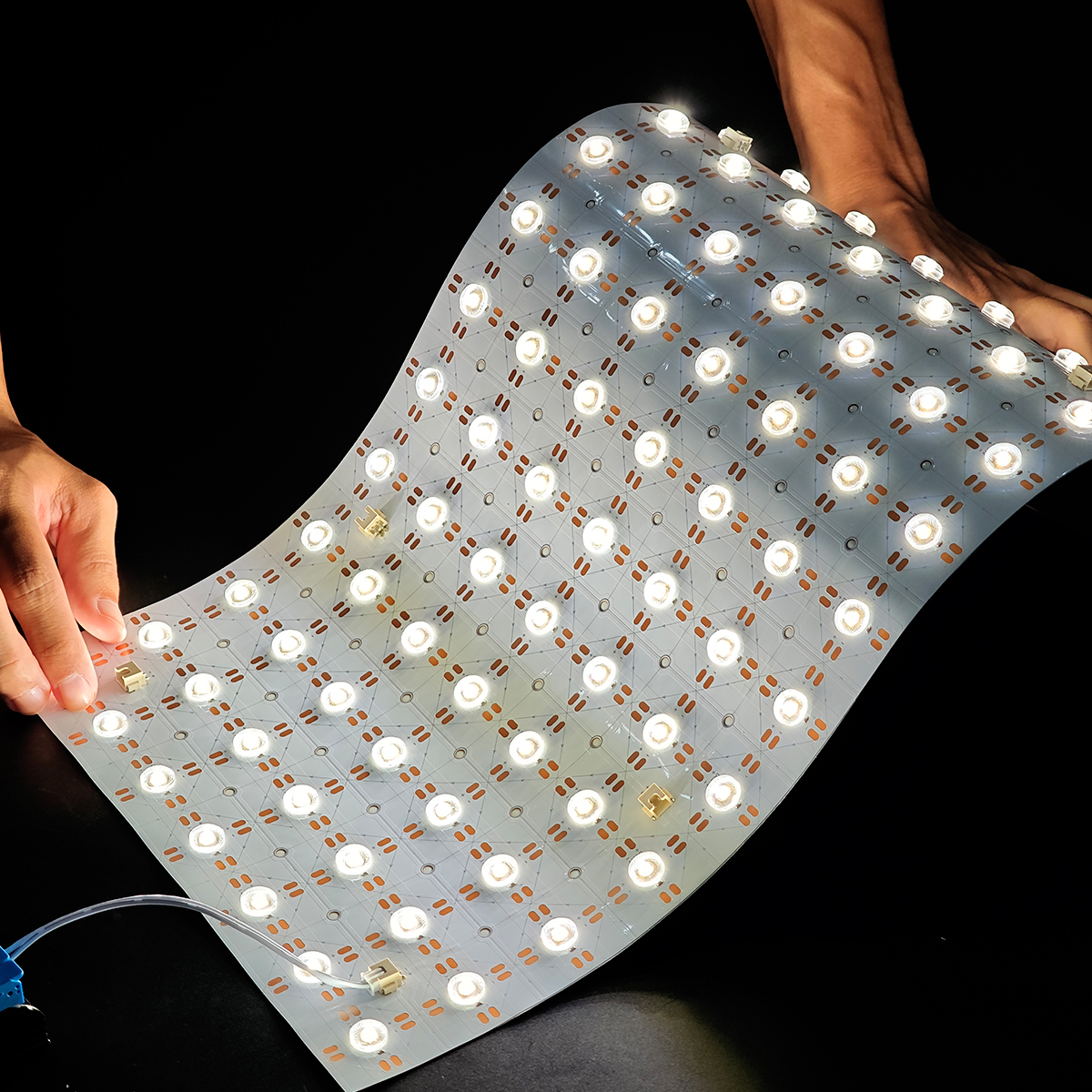
An LED backlight sheet is a thin lighting panel that distributes LEDs across a flexible circuit board. Instead of producing light along a single line, it creates illumination across a two-dimensional area.
This matrix-style layout is especially useful behind translucent materials. By distributing the light sources across the full illuminated surface, a flexible light sheet can reduce the stripes, shadows and concentrated bright points commonly associated with widely spaced linear LED strips.
SYPLED’s flexible LED backlight sheet solutions are designed for stone, signage, furniture, cabinets and custom architectural displays. Available options include white-light lens panels, three-color-temperature panels and full-color RGB sheets.
How Does an LED Light Sheet Work?
Each sheet contains multiple LED modules arranged across a flexible substrate. Depending on the model, optical lenses may be installed over the LEDs to spread the light over a wider area and improve penetration through translucent stone.
The panels operate on 24V DC low voltage and connect to a compatible constant-voltage driver. Multiple panels can be laid out across a surface and electrically connected according to the system design and maximum permitted load.
Selected models can be trimmed along designated cutting paths. This allows installers to fit the light source around corners, cabinet hardware, structural supports and irregular architectural shapes.
LED Backlight Sheet vs. Conventional LED Strip
| Comparison | LED Backlight Sheet | Conventional LED Strip |
|---|---|---|
| Light distribution | Two-dimensional area illumination | Linear illumination |
| Surface uniformity | Designed to reduce visible lines and hot spots | May show lines when strips are spaced too far apart |
| Installation depth | Suitable for low-profile backlighting assemblies | May require more diffusion distance for even coverage |
| Irregular shapes | Flexible and cuttable on designated paths | Flexible in one direction but requires multiple strip runs |
| Installation layout | Covers a broad area with modular sheets | Requires spacing and alignment of individual strips |
| Best applications | Stone, signs, lightboxes, feature walls and displays | Edges, shelves, coves and linear accent lighting |
Key Benefits of Flexible LED Backlight Sheets
1. Uniform Surface Illumination
The distributed LED layout helps create a consistent field of light across large surfaces. This is essential when backlighting polished stone, printed graphics, acrylic panels or other materials that can reveal imperfections in the lighting system.
2. Flexible and Bendable Construction
Flexible light sheets can follow curved and irregular surfaces that are difficult to illuminate with rigid light boxes. Potential installation areas include curved counters, columns, display cabinets, arched details and custom furniture.
3. Cuttable Modular Design
Designated cutting areas give installers greater freedom when working around internal obstacles or non-standard shapes. This can reduce the amount of custom fabrication required for one-off architectural projects.
4. Thin Profile
A slim lighting layer helps designers reduce the depth of backlit assemblies. This is valuable in kitchen islands, reception desks, retail displays and wall features where interior space is limited.
5. 24V Low-Voltage Operation
The 24V DC design supports professional low-voltage lighting layouts when used with a compatible driver. Compared with lower-voltage alternatives at the same wattage, 24V operation can reduce current and make larger lighting layouts easier to manage.
6. Faster Installation
Modular panels can reduce the time needed to measure, space and align multiple parallel LED strips. Self-adhesive options also simplify mounting on properly prepared surfaces.
7. Adjustable Lighting Options
Different projects require different visual effects. SYPLED offers monochrome, dual-color, three-CCT and RGB full-color options, allowing the lighting system to complement the material and intended atmosphere.
Comparing SYPLED LED Backlight Sheet Options
The correct panel depends on the illuminated material, desired color effect, project dimensions and control requirements. The following three product types address different application needs.
| Product | RGB Flexible Panel | 98-LED Lens Panel | 3-CCT Dimmable Sheet |
|---|---|---|---|
| Size | 500 × 250 mm | 500 × 250 mm | 245 × 500 mm |
| Voltage | DC 24V | DC 24V | DC 24V |
| Power | 25W per panel | 25W per panel | 36W |
| LED configuration | 312 × 5050 LEDs | 98 × 2835 LEDs with lenses | SYP-BL312D-3CCT |
| Color options | RGB full color | Monochrome or dual color | 3000K / 4000K / 6000K |
| Recommended use | Entertainment walls, bars, displays and color-changing features | Stone countertops, kitchen islands and high-penetration backlighting | Cabinets, displays and adjustable architectural lighting |
RGB Flexible Marble Light Panel
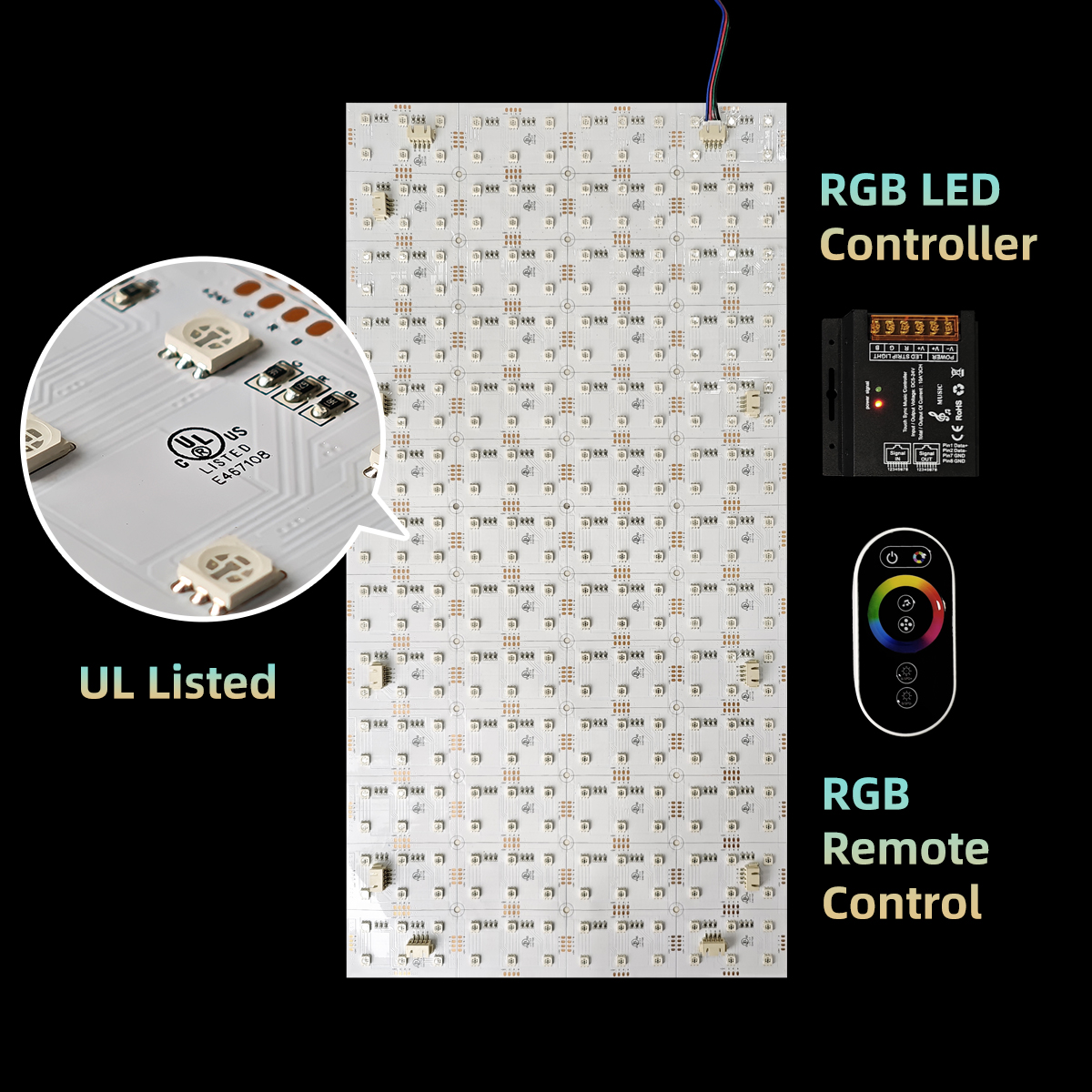
The RGB flexible LED light sheet measures 500 × 250 mm and uses 312 pieces of 5050 LEDs. It operates at DC 24V with a rated power of 25W per panel.
RGB output, remote control and music synchronization make this model suitable for decorative projects where the lighting must change with events, branding or atmosphere.
- RGB full-color output
- 500 × 250 mm flexible panel
- 312 pieces of 5050 LEDs
- DC 24V, 25W per panel
- Cuttable design
- Suitable for TV walls, bars, wine cabinets and hotel displays
98-LED Lens Flexible Marble Backlight Panel
The 98-LED lens flexible marble backlight panel is designed for projects that require concentrated light penetration through translucent stone.
It measures 500 × 250 mm, uses 98 pieces of 2835 LEDs and consumes 25W per panel at DC 24V. Integrated optical lenses spread and direct the light, making the panel particularly suitable for illuminated countertops and luxury kitchen islands.
- 500 × 250 mm panel size
- 98 pieces of 2835 LEDs
- Optical lens design
- DC 24V, 25W per panel
- Monochrome and dual-color options
- Flexible, cuttable and self-adhesive construction
LED Backlight Sheet 3 CCT Dimmable 24V 36W
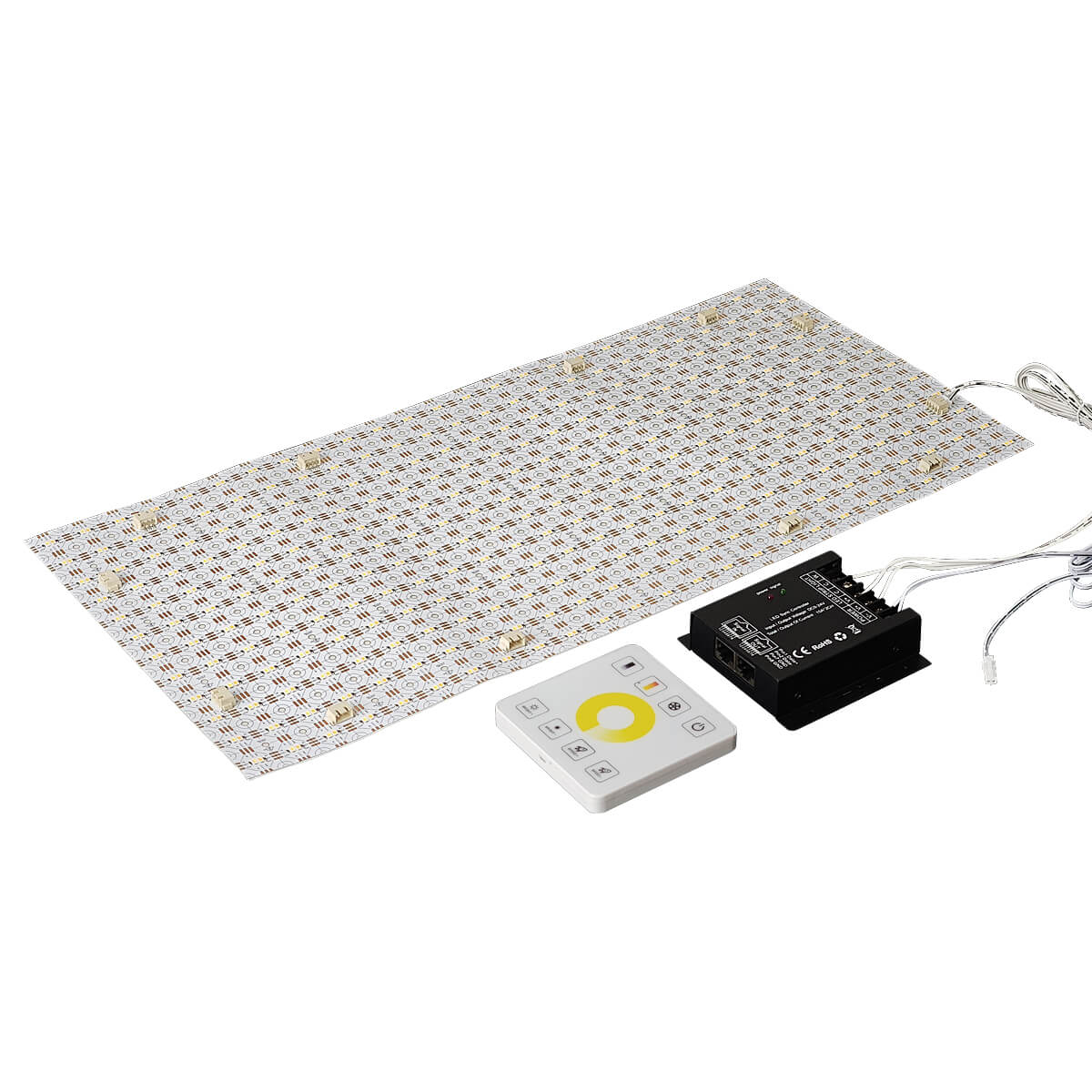
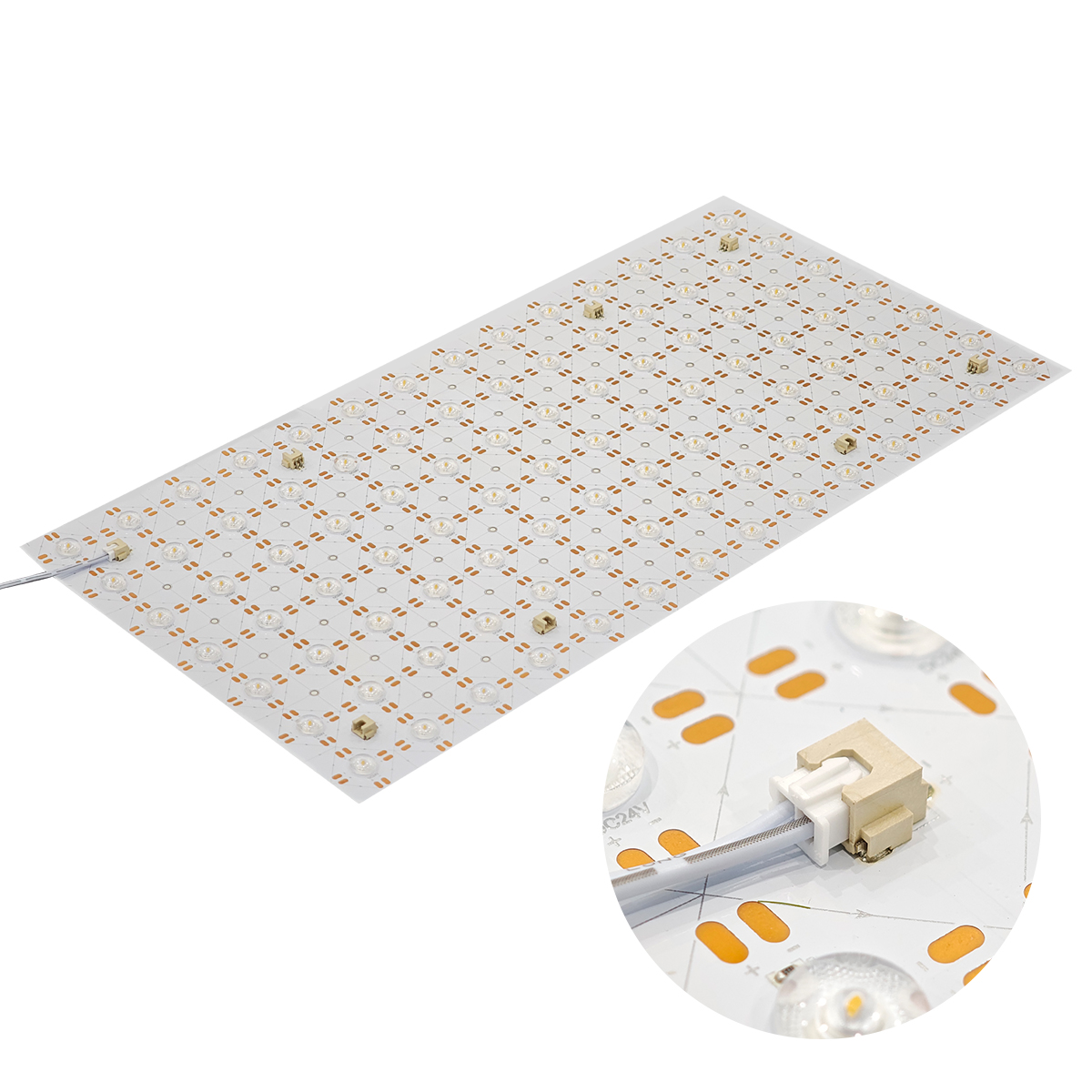
The 24V three-CCT LED backlight sheet allows installers to select 3000K, 4000K or 6000K. This makes it easier to coordinate the backlight with warm stone, neutral interiors or cooler commercial displays.
- Model: SYP-BL312D-3CCT
- Dimensions: 245 × 500 mm
- Voltage: DC 24V
- Power: 36W
- Color temperatures: 3000K, 4000K and 6000K
- Ingress protection: IP20
Because this model is rated IP20, it should be installed in a dry interior location unless it is incorporated into a properly designed protective enclosure.
View the complete range of commercial LED backlight sheets and panels to compare white, tunable and RGB options.
Where Are LED Backlight Sheets Used?
Translucent Stone and Marble Backlighting
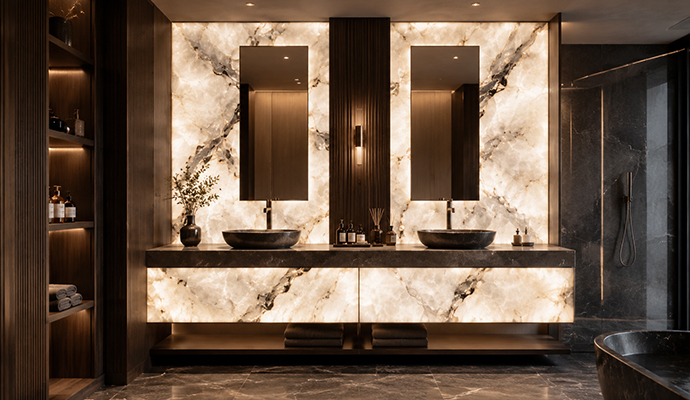
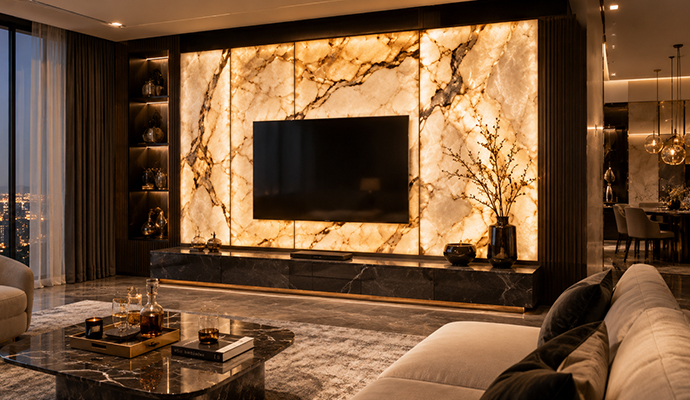
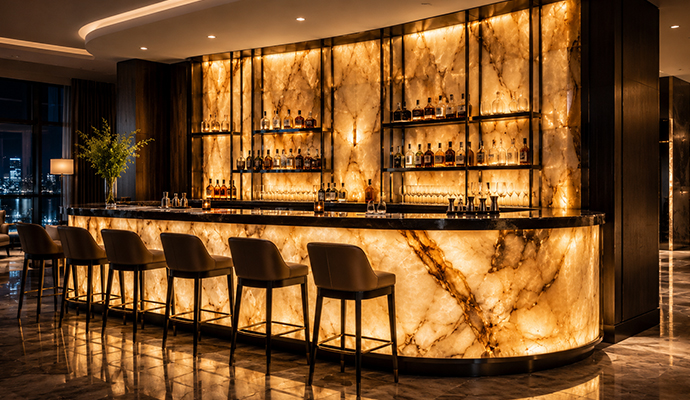
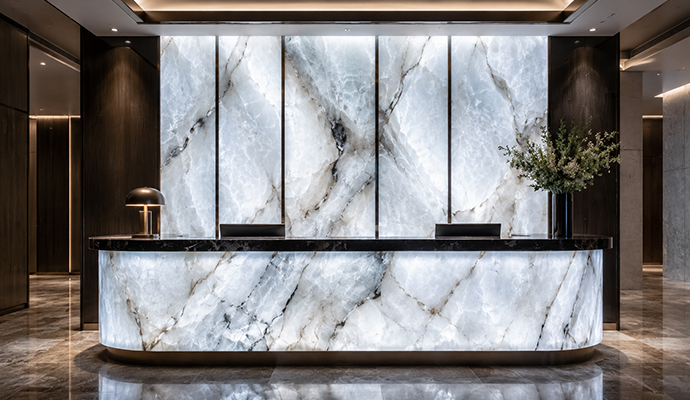
Natural onyx, selected marble, quartz, alabaster and engineered resin can become illuminated architectural surfaces. A flexible sheet distributes light behind the material, revealing its veining, texture and depth.
Common stone applications include kitchen islands, countertops, bar fronts, bathroom vanities, reception desks and full-height feature walls.
Retail Displays and Showcases
Uniform backlighting can draw attention to merchandise without placing visible fixtures inside the display. It is suitable for jewelry showcases, cosmetics displays, wine cabinets, branded shelving and point-of-sale fixtures.
Illuminated Signage and Lightboxes
LED light sheets can illuminate logos, printed graphics and acrylic signage while keeping the lightbox relatively slim. Consistent surface output helps prevent dark corners and unwanted bright lines in the finished sign face.
Cabinets and Custom Furniture
Furniture manufacturers can integrate flexible panels into glass cabinets, wardrobe back panels, shelving systems and decorative furniture. The slim construction keeps the light source concealed while allowing the illuminated surface to become part of the design.
Hospitality and Commercial Interiors
Hotels, bars, restaurants and corporate offices can use backlit panels to create visual landmarks. RGB models provide dynamic color for entertainment environments, while white and adjustable-CCT models support premium architectural interiors.
How to Select the Right LED Backlight Sheet
1. Test the Translucent Material
Different materials transmit light differently. Thickness, color, veining, opacity and surface finish all affect the final result. Dark or dense stone may require higher-output lighting or optical lenses, while lighter materials may achieve the desired effect with lower output.
Testing a sample of the actual stone, acrylic or printed graphic before production is strongly recommended.
2. Choose the Required Color
- Warm white: Complements amber onyx, wood and hospitality interiors.
- Neutral white: Provides a balanced appearance for stone, displays and workspaces.
- Cool white: Suits selected commercial signs and contemporary interiors.
- Dual color or 3-CCT: Allows adjustment during installation.
- RGB: Creates dynamic color effects for entertainment and branded environments.
3. Calculate the Illuminated Area
Measure the complete backlit area and note all penetrations, brackets, corners and irregular edges. Use these dimensions to create a panel layout before ordering.
4. Confirm Installation Depth
The distance between the LEDs and the front material affects visual uniformity. The required depth depends on LED spacing, optical lenses and material diffusion. A physical mock-up is the most reliable way to establish the correct spacing.
5. Plan Dimming and Controls
Decide whether the finished system needs simple on/off control, brightness adjustment, selectable white light or RGB color control. The driver and controller must match the panel’s voltage, load and color configuration.
6. Consider the Installation Environment
Confirm whether the panel will be used in a dry interior, damp location or protected exterior assembly. IP20 products are intended for dry indoor conditions and require additional protection if used near moisture.
LED Backlight Sheet Installation Guide
- Inspect the mounting surface. Make sure the substrate is clean, dry, flat and free from grease, dust or loose particles.
- Create a panel layout. Plan panel positions, cutting paths, cable routes, connection points and driver locations before mounting.
- Trim only where permitted. Follow the cutting indicators provided for the specific LED sheet.
- Mount the panels securely. Apply self-adhesive sheets to a suitable prepared surface. Vertical or overhead installations may require additional mechanical support.
- Connect panels correctly. Observe polarity and follow the maximum current and power limits specified for the selected product.
- Install a compatible 24V driver. Match the driver output voltage to the LED panels and ensure it has sufficient wattage capacity.
- Test before closing the assembly. Check brightness, color temperature, dimming and surface uniformity before installing the final stone or graphic panel.
- Keep serviceable components accessible. Drivers and control modules should be positioned where they can be inspected and replaced without dismantling the finished feature.
How to Calculate Driver Wattage
Add the rated power of every panel connected to the driver:
Total connected load = Number of panels × Watts per panel
For example, eight 25W panels create a connected load of 200W. The selected driver must be rated for 24V DC and provide adequate capacity in accordance with the driver manufacturer’s loading guidelines.
Browse compatible 24V LED drivers and controls when planning the complete lighting system.
OEM and Custom LED Backlight Sheet Solutions
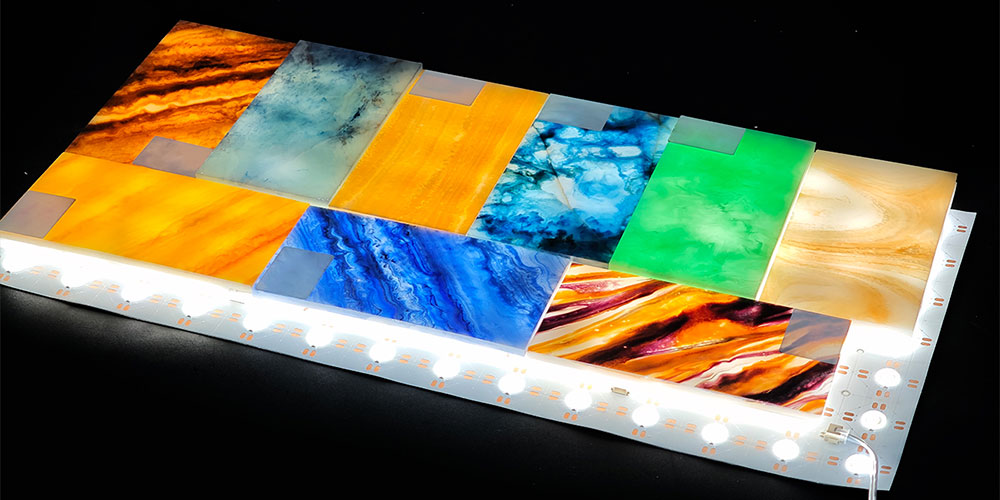
Standard panels do not meet every architectural or commercial requirement. SYPLED supports distributors, signage companies, lighting brands, designers and contractors with custom LED light sheet solutions.
Available customization services include:
- Custom panel dimensions and shapes
- Custom color and color-temperature configurations
- Project-specific power and control solutions
- Private labeling and branded packaging
- Technical drawings and project documentation
- OEM and ODM production support
- Custom samples for project evaluation
For the most accurate recommendation, provide the illuminated dimensions, material type, material thickness, required color, control method and available installation depth.
Frequently Asked Questions About LED Backlight Sheets
Can LED backlight sheets be cut to size?
Selected flexible LED sheets can be trimmed along designated cutting paths. Do not cut through LEDs or active circuits. Always follow the cutting diagram for the specific product.
Can an LED light sheet be installed behind marble?
Yes. Flexible LED light sheets are suitable for translucent marble, onyx, quartz, resin and similar materials. The stone should be tested because its thickness, density and color affect light transmission.
What is the best LED panel for a backlit kitchen island?
A lens-equipped panel can be a strong choice for a stone kitchen island because its optical lenses help direct light through the material. Final selection should be based on a physical sample test.
What is the difference between RGB and 3-CCT panels?
RGB panels create multiple decorative colors and dynamic effects. A 3-CCT panel provides selectable shades of white, such as 3000K, 4000K and 6000K. RGB is generally chosen for entertainment or branding, while 3-CCT is suited to adjustable architectural white light.
Are LED backlight sheets dimmable?
Dimmability depends on the selected panel, driver and controller. All components must use compatible voltage, power and control protocols.
Can flexible LED light sheets wrap around curved surfaces?
Their flexible construction allows them to follow many concave, convex and cylindrical surfaces. Observe the product’s permitted bending limits and avoid sharp creases that could damage the circuit.
Can these panels be used in bathrooms?
The IP rating and enclosure design must match the installation environment. An IP20 panel is intended for dry interior use and should not be exposed directly to water or moisture.
Can I order a custom sample?
Yes. Samples can help verify brightness, color, material compatibility and installation depth before full production. Custom project requirements can be submitted to SYPLED for evaluation.
 How to Choose an LED Backlight Sheet for Stone, Signs and Custom Displays
  About us
 OUR PARTNER
 faq
faq Contact us